
Short Form Video Agencies and Services: How to Choose and Buy
Os artigos são escritos em inglês.
Short Form Video Agencies and Services: How to Choose and Buy
What Is Short Form Video and Why It Converts
Short form video runs 6–60 seconds and lives primarily on TikTok, Instagram Reels, YouTube Shorts, and LinkedIn. The format is not a trend — it's the dominant mode of content consumption for billions of users, and the platforms continue to reward it with algorithmic reach that paid placements can't always replicate.
What makes it convert? Two things: the hook and the format. A strong opening frame — whether it's a bold claim, a visual pattern interrupt, or a question — stops the scroll in under two seconds. Captions keep viewers watching even with sound off, which accounts for roughly 85% of mobile viewing. Together, these elements push watch time up and click-through rates with it.
Within the funnel, short form video earns its keep at the top and middle. It introduces cold audiences to a brand, product, or offer with low friction. It also retargets warm audiences who've already visited a site or engaged with previous content, moving them closer to a decision. Native-style content — shot vertically, aligned with current sounds and trends — consistently outperforms repurposed cuts from long-form ads. The algorithm knows the difference, and so does the audience. Pair that native feel with a direct CTA and clear offer framing, and views become leads.
Who Needs a Short Form Video Service
Use Cases by Industry
Direct-to-consumer brands need volume and variety — product demos, testimonials, unboxing moments, and seasonal hooks running simultaneously across multiple SKUs. SaaS companies convert FAQs, feature walkthroughs, and customer success moments into bite-size social proof that sales teams can share mid-cycle. Local service businesses — clinics, law firms, contractors — build trust and local SEO signals through consistent, location-aware content. Creators and personal brands scale their presence without burning out by partnering with a dedicated short form content creator who handles scripting, editing, and scheduling.
Team Size Considerations
Founders and lean marketing teams are often the clearest candidates for outsourcing. Scripting, filming, editing, formatting for multiple platforms, and posting with optimized metadata is a full-time operation. Handing that to specialists frees internal bandwidth for strategy and offers.
Larger teams benefit differently. An in-house creative team might retain filming but outsource editing and optimization. Sales-led organizations can turn existing demo recordings or FAQ responses into polished short form assets without rebuilding their workflow from scratch. Launches and seasonal campaigns that spike production demand are also natural moments to bring in external capacity rather than hiring.
How to Evaluate Short Form Content Companies
Performance Proof
Portfolios look nice. Numbers matter more. When vetting short form content companies, ask for case studies that include watch time percentages, hook rates (the percentage of viewers who watch past the first three seconds), CTR, and — where available — cost-per-acquisition impact. A vendor who can't speak to these metrics likely isn't optimizing for them.
Creative Capabilities
Scroll through their work with the sound on and then again with it off. Good vertical editing holds attention either way. Look for clean motion graphics, accurate captions, smart sound design, and transitions that feel native to each platform rather than copy-pasted across all of them. Ask whether they've produced content specifically for your primary channels. TikTok culture and LinkedIn culture are not the same, and trend fluency on one does not automatically transfer to the other.
Compliance and Brand Safety
Rights management is easy to overlook until it creates a problem. Confirm that the short form video service you're considering has proper UGC usage consent in place for any creator-sourced content. Understand their whitelisting capabilities if you plan to run paid amplification. Get clarity on who owns the raw files, the final edits, and any music licensing. Also review their turnaround SLAs, revision policy, and how they handle communication — a missed deadline on a product launch is expensive.
Pricing Models and Packages from Short Form Video Companies
Common Packages
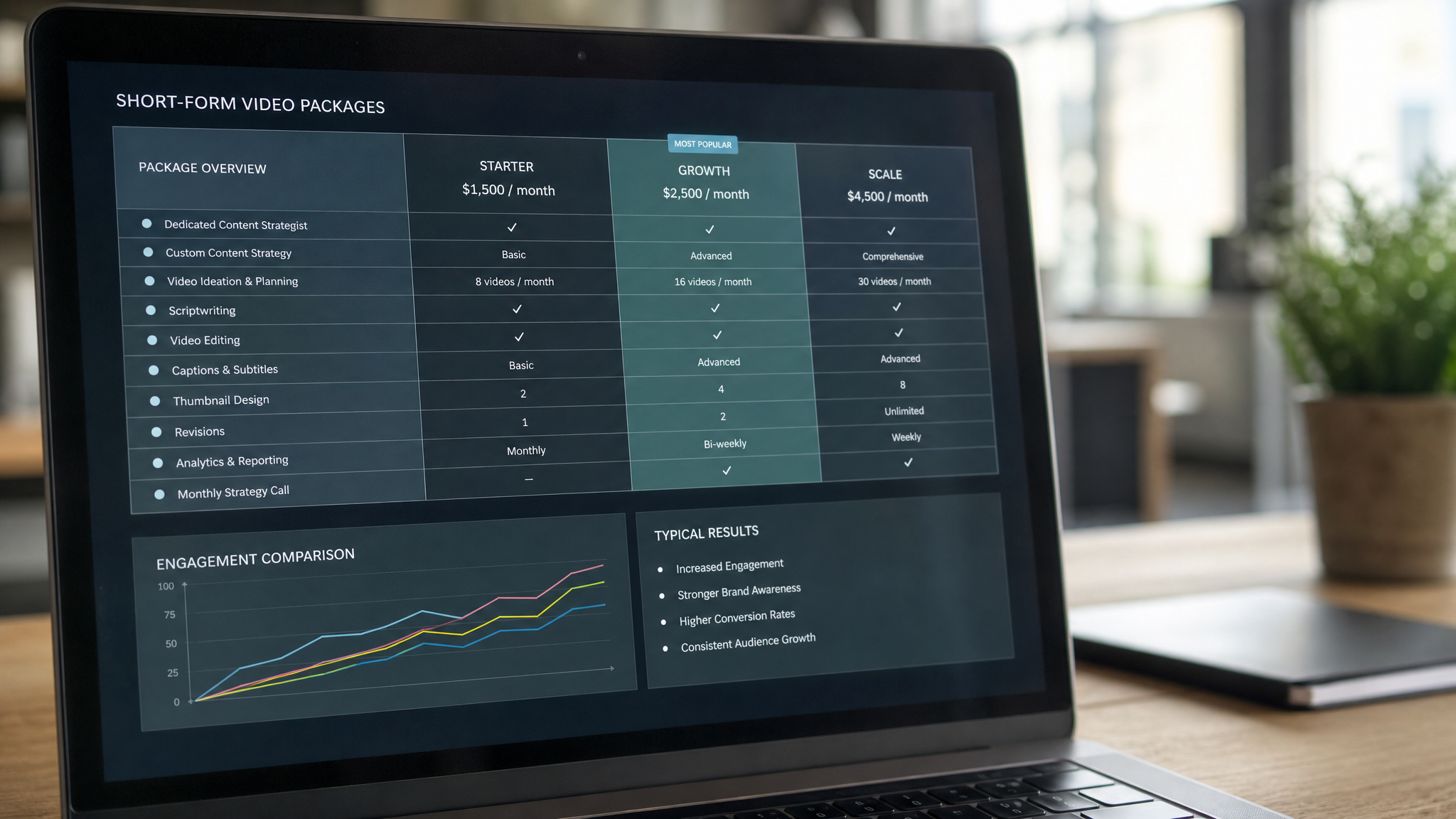
Short form video companies typically offer per-video pricing or monthly retainers with volume tiers. Per-video rates can range from $150 to $1,500 or more depending on complexity, creator sourcing, and platform formatting requirements. Retainers usually bundle a set number of deliverables per month — 8, 16, or 24 videos is common — with a discount per unit at higher volumes.
Add-Ons and Hidden Costs
End-to-end production (scripting, filming, editing, posting) costs more than editing-only engagements, and the ROI calculation differs between them. Talent fees for UGC creators, usage rights for licensed music, and paid amplification permissions are frequently priced separately. Hook testing, thumbnail creation, and caption copywriting may or may not be included in a base package. Know exactly what's in scope before signing.
How to Compare Quotes
The cleanest way to compare vendors is to standardize on cost per edited minute and map that against the full deliverables list. Two quotes at the same monthly fee can represent very different volumes, revision limits, and platform coverage. Ask each short form video service to itemize what's included and what triggers additional charges.
Workflow: From Brief to Publish with a Short Form Content Creator
Pre-Production
A good short form content creator starts with a creative brief — not a mood board, a brief. That means your ideal customer profile, the specific offers or messages you're promoting, platform-specific goals, and any brand guardrails (tone, visual identity, competitor sensitivity). From there, hooks get outlined first, because the hook determines whether everything else matters. Scripts, shot lists, and format specs follow.
Production and Edits
Most professional workflows include one to two rounds of revisions. Expect the first cut to come formatted for each target platform with captions and at least one alternate hook — same core content, different opening angle. This lets you test what resonates without doubling production costs. Sound design, pacing, and on-screen text should all be reviewed in the context of how the video will appear in-feed, not in a preview window.
Publishing and Optimization
Publishing is not the end of the workflow. Metadata — hashtags, descriptions, geo-tags — affects discoverability on every platform. Posting cadence matters: consistent frequency signals relevance to algorithms. After a few weeks of data, implement A/B tests for hooks, CTAs, and first-frame thumbnails. The best short form video creator partnerships treat publishing as the beginning of an optimization loop, not the finish line.
RFP Checklist and Questions to Ask a Short Form Video Creator
Must-Have Requirements
Define your KPIs before sending any brief. Are you optimizing for watch time, follower growth, click-through, lead volume, or all of the above? Specify target platforms, monthly volume, content categories, and creative guardrails. This gives vendors enough context to submit meaningful proposals rather than generic deck responses.
Decision-Making Questions
Ask for sample scripts in your niche. Request raw-to-final comparisons so you can assess editing quality independently of the source footage. Ask for a pilot proposal — a defined trial period with clear success metrics — before committing to a six-month retainer.
Clarify how reporting works: What metrics are tracked? How often? Through what dashboard or format? Confirm attribution methodology if you're running paid amplification alongside organic. Nail down rights and usage windows — how long can you repurpose a video, and on which channels?
Finally, ask about onboarding: timeline, primary point of contact, and escalation path if something goes wrong. The answers tell you a lot about how the vendor actually operates, not just how they present themselves.
Choosing the right short form video service is ultimately a question of alignment — between your goals, their expertise, and the metrics you'll hold each other accountable to. Get that alignment right, and the production side takes care of itself.